

Pervaziv AI Advances Trusted Agentic Engineering with Cortex 4.7 Validation, Security Remediation and AI Governance
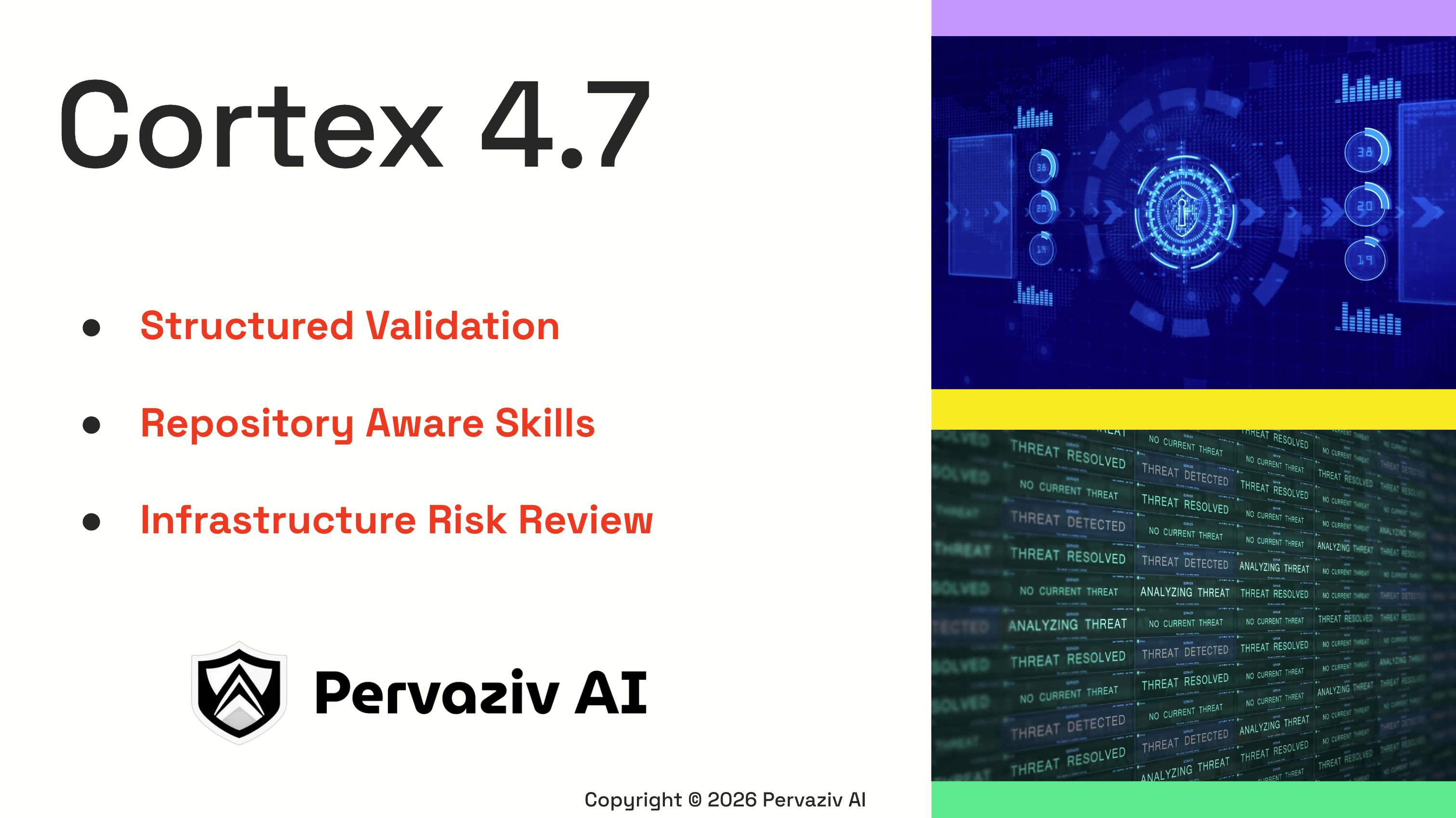
Cortex 4.7 - Trusted Agentic Engineering

New release advances Enterprise AI Control Layer with stronger validation, repository-aware guidance, security remediation and infrastructure risk review.
SAN FRANCISCO , CA, UNITED STATES, June 15, 2026 /EINPresswire.com/ -- Pervaziv AI today announced Cortex 4.7, the latest release of its Enterprise AI Control Layer for secure software development, AI assisted engineering, and DevSecOps workflows.
Cortex expands the platform’s focus from AI generated code to trusted engineering outcomes. The release strengthens post-change validation, repository-aware guidance, structured security analysis, remediation governance, and dependency and infrastructure risk review. Together, these advancements help engineering and security teams move faster while maintaining enterprise controls.
As organizations accelerate adoption of AI coding assistants, security copilots, and agentic engineering systems, a new priority is emerging. Teams do not only need AI to generate code or identify issues. They need AI driven changes to be validated, explained, governed, and reviewed in the context of real software projects.
Cortex was designed around that shift.
The release helps organizations move from isolated AI suggestions to a more complete AI assisted development lifecycle. Code changes can be evaluated against project expectations. Security findings can be connected to remediation workflows. Dependency and infrastructure risk can be reviewed as separate categories of enterprise exposure. Engineering leaders gain clearer evidence around what was checked, what remains unresolved, and whether a change is ready for review.
“AI is entering the core of enterprise software delivery, but organizations cannot rely on speed alone,” said Anoop Jaishankar, Founder and CEO of Pervaziv AI. “Cortex 4.7 is about trust, validation, and control. We are building Cortex so engineering and security teams can use AI to move faster while still knowing what changed, what was checked, what risk remains, and why a decision is ready for review.”
From AI Coding Assistance to Trusted Engineering Control
-----------------------------------------------------------------------------
Cortex has evolved from an AI coding and security assistant into a broader enterprise control layer for secure agentic engineering. Cortex continues that progression by focusing on the trust layer enterprises need when AI becomes part of day to day software delivery.
Traditional AI coding tools emphasize speed and output. Enterprise environments require more. Software changes must meet review expectations, security findings must be prioritized, remediation validated, and infrastructure and dependency risks made visible to the right teams.
Stronger Post-Change Validation for AI Assisted Development
----------------------------------------------------------------------------------
One of the key advancements in Cortex is stronger post-change validation. In enterprise software development, a generated patch is not the finish line. A change must be evaluated against quality, build, test, style, and review expectations before it can be considered ready.
Cortex improves how teams understand the state of an AI assisted change after edits are made. The release emphasizes validation evidence, residual issue visibility, affected file awareness, and clearer summaries around what is ready for review and what still needs attention.
This helps reduce risks associated with AI generated code, including incomplete fixes, hidden regressions, broken build behavior, and changes that do not align with project requirements. Developers spend less time interpreting disconnected outputs and more time moving toward verified changes.
Repository-Aware Guidance for Enterprise Engineering Teams
----------------------------------------------------------------------------------
Cortex strengthens repository-aware guidance, helping the product experience better align with project standards, engineering preferences, and security practices. Enterprise codebases contain architecture patterns, review expectations, coding conventions, remediation preferences, and risk assumptions that generic AI tools often overlook.
By supporting a more project-aware experience, Cortex helps teams apply AI assistance in a way that reflects how their organization actually builds software. This reduces the gap between generic AI output and enterprise-ready implementation guidance.
The release also supports more governed workflow orchestration across AI assisted development activity, reinforcing user control, auditability, and trust.
Structured Validation and a More Disciplined Engineering Lifecycle
-----------------------------------------------------------------------------------------
Cortex advances a more structured validation model for modern software development. Projects often rely on multiple quality gates, including tests, style checks, type checks, build checks, static analysis, and security review.
The release helps teams reason about validation results more clearly. Instead of treating output as raw text, Cortex moves toward structured validation intelligence that supports clearer summaries, issue understanding, and next-step guidance.
When a change exposes a problem, the workflow can move through review, correction, validation, and summary, helping organizations reduce rework and make AI assisted changes easier to evaluate before entering delivery pipelines.
Security Analysis Connected to Remediation and Risk
-----------------------------------------------------------------------
Cortex deepens the connection between security findings, code context, remediation planning, and residual risk. Many security tools identify issues, but enterprise teams often struggle with prioritization, remediation, and verification.
The release strengthens the security remediation lifecycle through improved context, prioritization, validation, revalidation, false positive handling, and remaining risk visibility. This helps engineering and security teams move beyond static issue lists toward a more operational model for secure software delivery.
For security leaders, this supports secure SDLC alignment, DevSecOps workflows, and audit-ready decision making. For developers, it makes findings more actionable by connecting security review directly to remediation and validation.
Dependency and Infrastructure Risk Review
----------------------------------------------------------
Cortex reinforces dependency and infrastructure risk review as part of the broader enterprise application security lifecycle. Modern application risk extends beyond source code to include third party packages, software supply chain exposure, configuration risk, infrastructure definitions, and cloud assets.
The release supports clearer separation between source code findings, dependency risk, and infrastructure related exposure. Each category often has different owners, remediation paths, severity models, and approval requirements.
Cortex helps organizations organize these risk categories more effectively so teams can prioritize based on severity, business impact, and remediation ownership.
Built for the Next Phase of Enterprise AI Adoption
------------------------------------------------------------------
Cortex reflects a broader shift in the enterprise AI market. The first phase of AI coding adoption focused on productivity and generation. The next phase will focus on trust, governance, validation, and secure delivery.
The platform is designed to help organizations bring AI into real software delivery environments while maintaining the controls enterprise teams require. Cortex combines secure coding assistance, cybersecurity automation, DevSecOps workflows, software risk visibility, and enterprise integrations into a unified AI control layer.
With Cortex, Pervaziv AI continues advancing its vision for secure agentic engineering, where AI helps teams build faster while supporting validation, governance, privacy, and risk management.
Pervaziv AI
Pervaziv AI
email us here
Visit us on social media:
LinkedIn
Instagram
YouTube
X
Other
Legal Disclaimer:
EIN Presswire provides this news content "as is" without warranty of any kind. We do not accept any responsibility or liability for the accuracy, content, images, videos, licenses, completeness, legality, or reliability of the information contained in this article. If you have any complaints or copyright issues related to this article, kindly contact the author above.
