

Amid Rapid Growth in Planetary Exploration, Engineer Sets Sights on Leading the Next Frontier of Space System Interiors
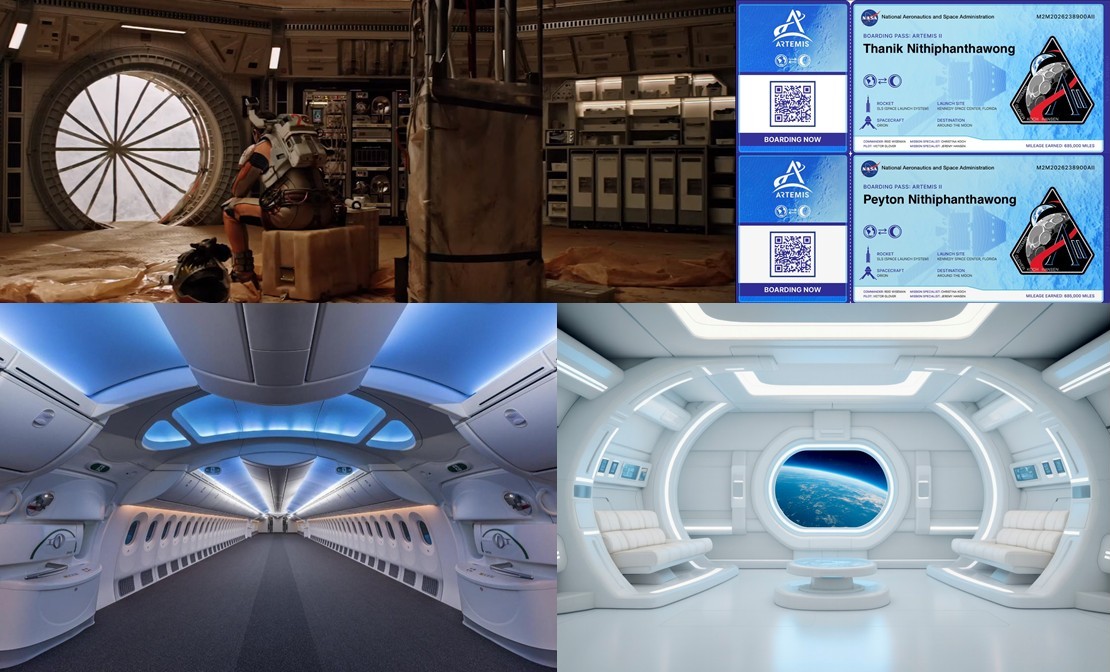
An engineer is positioning himself to lead the next frontier of space system interiors as human exploration expands beyond Earth.
This is the moment for space system interiors to enter the spotlight. There's a calling for this type of dedicated focus.”
LOS ANGELES, CA, UNITED STATES, February 2, 2026 /EINPresswire.com/ -- For decades, spacecraft design has prioritized reusability, structural integrity, engineering efficiency, and mission operations. However, as human presence in space expands, the emphasis of space exploration is gradually extending from rockets and propulsion systems to how people will actually live, work, and thrive beyond Earth. Consequently, the need for space system interiors capable of sustaining these activities safely and comfortably has emerged.— Thanik Nithiphanthawong
The idea of an engineering center for interiors in space is therefore becoming increasingly important. Similar to the evolution of aircraft cabin design, architecture, and industrial design, environments are developed to enhance human experience and commercialization of operations. For space applications, interiors must be purposefully engineered to support long-duration habitation, psychological well-being, and operational effectiveness. This requires not only functional considerations such as ergonomics, modularity, and integration with life-support systems, but also human factors including comfort, spatial perception, aesthetics, and adaptability to different mission profiles.
"This is the moment for space system interiors to enter the spotlight," said Thanik Nithiphanthawong, engineer who has accomplished cabin development for both commercial aircraft and human spaceflight, and is currently looking into creating space system interiors as a project codenamed Fanthom. "There's a calling for this type of dedicated focus, driven by the inception of the commercial space industry comparable to commercial aviation that has been growing for a century."
The phenomenon is further fueled by NASA's Artemis program, which aims to establish a sustained human presence on the Moon and ultimately pave the way for Mars missions. As space missions advance past suborbital flight and Earth orbit, interiors will play a critical role in enabling astronauts and future space travelers to perform effectively while maintaining physical and mental health. Interiors can no longer be considered secondary components or afterthoughts but must be recognized as a fundamental aspect of space system design, requiring interdisciplinary collaboration across multiple fields of expertise.
In The Martian, a sci-fi film released in 2015, there is a scene showing astronaut Mark Watney (played by Matt Damon) sitting inside a habitat with the interior compartments on the right that are often cropped out in online images. This section strongly resembles airplane galleys with trolley carts, which are crucial for passenger survivability during prolonged airborne operations. While this example is fictional, the underlying principle of sustaining humans in remote environments remains highly relevant.
For a more tangible and immediately attainable comparison, the interior of a Boeing 787 airplane serves as a compelling reference. When all seats and cabin fixtures are removed, the cabin begins to look remarkably like a conceptual space interior as one might envision it, sharing the common goal of keeping people alive during ascent into the atmosphere. This illustrates the existing body of knowledge that can be utilized as building blocks to enable the next bold frontier: space inhabitation.
Even so, significant challenges remain. "Space systems will be produced in low volumes, highly customized, and subject to complex supply chain constraints, including ITAR restrictions. Whereas airplanes are manufactured in the hundreds to thousands, the number may be fewer than ten for space systems," said Thanik.
To address this dilemma, he intends to adopt innovative approaches in design and manufacturing to achieve acceptable costs while continuing to prioritize safety, drawing on experience, skill, and mindset that has been compounding for nearly 20 years in developing aerospace technologies that can be commercialized. The strategy basically involves augmenting the functionality of commercial aircraft systems to be space-compatible, with practices that can be applied back to aviation for further technological advancement. The result would yield an interior system that delivers space-grade reliability while remaining viable for out-of-this-world maintenance, repair, and overhaul services.
In addition to safeguarding humanity in air and space, Thanik is cheering for Artemis II alongside his son, Peyton Nithiphanthawong, by sending their names to orbit around the Moon. He encourages everyone to keep their dreams alive just as space system interiors will do to support lives throughout the galaxy.
Thanik Nithiphanthawong
Engineer and Innovator
email us here
Legal Disclaimer:
EIN Presswire provides this news content "as is" without warranty of any kind. We do not accept any responsibility or liability for the accuracy, content, images, videos, licenses, completeness, legality, or reliability of the information contained in this article. If you have any complaints or copyright issues related to this article, kindly contact the author above.
